Two homeowners can have nearly identical-looking chimney problems and end up with wildly different price tags — one paying $800 for tuckpointing, the other paying $10,000 for a partial rebuild. The difference isn't bad luck. It's where the damage is, how deep it goes, and how long it was left untreated. Knowing which side of that line your chimney is on can save you thousands.
At RCC Masonry & Concrete, we evaluate dozens of chimneys every year across McHenry County and Lake County. This guide walks through the exact decision criteria we use on a site visit — what gets repaired, what gets rebuilt, and why getting that call right is so important. If you've been told you need a rebuild, this also helps you ask the right second-opinion questions.
The Two Categories of Chimney Damage
Chimney problems fall into two buckets. Surface damage means the brick units and overall structure are sound but the protective layer (mortar joints, crown, flashing, cap) has failed. Surface damage is what tuckpointing, crown rebuilds, and flashing replacement fix. Structural damage means the actual bricks or the chimney's geometry have been compromised — bricks crumbling through their full thickness, courses shifted out of plumb, cracks extending through multiple bricks rather than just mortar. Structural damage requires removing and replacing the affected sections.
Surface damage left untreated almost always progresses into structural damage. That's why we tell every McHenry and Lake County homeowner to inspect their chimney every spring — the window between "$800 repair" and "$8,000 rebuild" can be as short as two or three bad winters.
When Chimney Repair Is the Right Answer
Repair-level work is appropriate when:
- • Mortar joints are deteriorated but bricks themselves are sound
- • The crown (cement cap) is cracked but the chimney structure is plumb
- • Flashing has failed but the surrounding brick is intact
- • A small number of individual bricks are spalled (less than 10–15% of total)
- • Efflorescence is present without underlying structural cracking
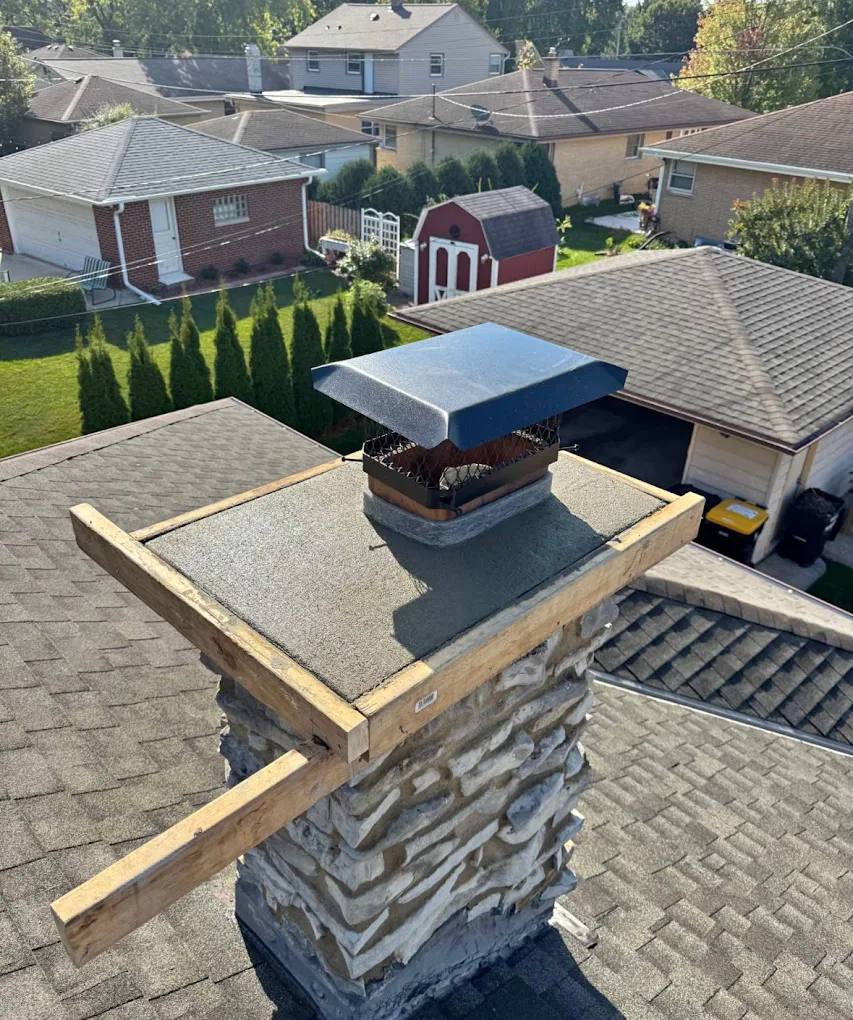
- • The cap is missing or damaged but everything else is sound
- • The chimney is plumb (no visible lean) and structurally stable
Common repair work includes tuckpointing the chimney stack ($800–$2,500), rebuilding or resurfacing the crown ($300–$1,500), replacing flashing ($400–$1,200), installing or replacing a chimney cap ($150–$500), and individual brick replacement ($20–$50 per brick installed). A complete chimney maintenance package — tuckpointing, new crown, flashing, and cap — typically runs $2,500–$4,500 and adds 25+ years of life if done before structural damage occurs.
When Chimney Rebuild Is Required
A partial or full rebuild becomes necessary when:
- • The chimney is leaning more than 1 inch from plumb
- • More than 30% of bricks are spalled, cracked, or deteriorated
- • Structural cracks run through multiple courses of brick (not just mortar joints)
- • Bricks are missing, dislodged, or have shifted out of position
- • The chimney has pulled away from the house (gap visible at the joint)
- • The interior flue is damaged enough to require liner replacement
- • A previous repair has failed and the underlying damage has progressed
- • Tuckpointing was attempted but bricks themselves are too soft to hold new mortar
Partial vs. Full Rebuild
Most chimney rebuilds in Northern Illinois are partial rebuilds from the roofline up. The section above the roof is the most exposed to wind, rain, snow, and freeze-thaw cycles, so it deteriorates first. Below the roofline, the chimney is partially protected by the attic envelope and usually stays in better condition. A partial rebuild costs $3,000–$8,000 depending on chimney height and brick selection.
A full rebuild from the firebox up ($8,000–$15,000+) is necessary when the damage extends below the roofline, when the chimney is leaning at the base, or when there's evidence of footing or foundation failure. Full rebuilds typically include a new flue liner ($1,500–$3,500 additional) and may require permits and structural review.
How We Make the Repair vs. Rebuild Call
On a typical site visit, we use this checklist:
- Plumb check. We use a 4-foot level on multiple sides of the chimney. Any lean over 1 inch from vertical points toward rebuild.
- Brick condition test. We tap bricks with the handle of a trowel. Solid bricks ring sharp; deteriorated bricks sound dull and hollow. We also check whether bricks crumble when scraped.
- Mortar joint test. A screwdriver press into joints tells us whether tuckpointing alone will hold. If the surrounding bricks are too soft to hold fresh mortar, the section needs replacement.
- Crown inspection. We visually inspect the crown for cracks, missing material, and improper overhang.
- Flashing inspection. We check for separated, rusted, or improperly installed flashing where the chimney meets the roof.
- Flue inspection. When possible, we visually inspect the flue or recommend a separate chimney sweep inspection.
- Photograph everything. We document conditions and walk the homeowner through the findings.
Why Procrastination Is So Expensive on Chimneys
Chimneys deteriorate exponentially, not linearly. Once water gets into the masonry — whether through a failed crown, deteriorated mortar, or missing flashing — every freeze-thaw cycle accelerates the damage. A chimney that needed $1,500 of tuckpointing in 2024 might need $4,000 of repair in 2026 and a $9,000 rebuild by 2028. We've watched this exact progression play out many times in McHenry and Lake County, especially on homes that haven't had a masonry inspection in 10+ years.
Safety Considerations You Can't Ignore
Beyond cost, chimney damage has safety implications. Falling brick can injure people and damage roofs, cars, and HVAC units. Cracked flue liners can let combustion gases (including carbon monoxide) leak into the home. Failing structures can collapse during high winds — and we've seen that happen, particularly with old, leaning chimneys. If your chimney is leaning visibly, dropping brick fragments, or showing structural cracks, it's not a "wait until spring" problem.
Getting a Second Opinion
If a contractor has quoted you a full rebuild, it's reasonable to get a second opinion — especially if the quote feels high or doesn't explain why repair won't work. A trustworthy masonry contractor will walk you through the specific conditions that drive the rebuild decision, show you photographs of the damage, and explain what would happen if you tried to repair instead. If you can't get clear answers, get another quote.
Free Chimney Assessment
RCC Masonry & Concrete provides free chimney inspections throughout McHenry County and Lake County. We give you an honest evaluation — if your chimney needs a $1,200 tuckpointing job and not a $9,000 rebuild, that's what we'll quote. We handle everything from routine chimney repair to full rebuilds, with related work in tuckpointing and masonry cleaning when needed. Call (224) 441-5284 or request a free inspection. We serve every community in our McHenry & Lake County service area.