Concrete that lasts 30 years in Phoenix can crumble in 8 years in McHenry County — and the homeowner is rarely told why. The answer is freeze-thaw: Northern Illinois sees 70 to 90 freeze-thaw cycles per winter, each one pushing water into your concrete, freezing it, expanding it by 9%, and slowly tearing the slab apart from the inside. The concrete that survives this climate isn't ordinary concrete. It's a very specific mix with specific reinforcement, poured over a specific sub-base, finished and cured in a specific way.
At RCC Masonry & Concrete, we specify our concrete mixes to ACI (American Concrete Institute) standards for ASTM C260 air-entrained Class F exposure — the most aggressive freeze-thaw classification. This guide walks through every spec we use and why it matters for a driveway, patio, or sidewalk in McHenry or Lake County.
Why Illinois Concrete Fails: The Freeze-Thaw Mechanism
Concrete is porous. Even high-quality concrete has microscopic capillaries that absorb water from rain, snowmelt, and ground moisture. When that absorbed water freezes, it expands. In a hot climate, this doesn't matter — water never freezes inside the slab. In Northern Illinois, it happens dozens of times each winter, and the cumulative damage is what destroys cheap concrete.
De-icing salt makes this dramatically worse. Salt doesn't just lower the freezing point of water — it pulls additional moisture into the concrete through osmosis, increases the number of freeze-thaw cycles per winter (because salt-saturated water freezes and re-freezes multiple times at different temperatures), and chemically attacks the cement paste. A driveway exposed to salt without proper mix design can show surface scaling within three winters.
Spec #1: PSI Rating (Strength)
PSI (pounds per square inch) measures compressive strength. For Northern Illinois exterior flatwork, our standard is a 4,000 PSI air-entrained mix, and we step up to 5,000 PSI for commercial applications, heavy-load slabs, and pool decks exposed to chlorine. Cheaper contractors often pour 3,000 or 3,500 PSI because it's $5–$10 per cubic yard cheaper at the plant — but the difference shows up after the third or fourth winter, when the weaker concrete starts to spall and crater.
Spec #2: Air-Entrainment (The Single Most Important Spec)
Air-entrained concrete contains 5–8% intentionally created microscopic air bubbles. These voids give freezing water somewhere to expand into, preventing the internal pressure that cracks ordinary concrete. For Class F (severe freeze-thaw + salt) exposure, ACI 318 requires 6.0–7.5% air content at the point of placement. We test air content with a Type B meter on every pour — if the truck arrives outside the spec, we reject the load.
Non-air-entrained concrete is acceptable for indoor slabs, interior garage floors (heated), and protected applications. For anything exposed to Illinois weather, air-entrainment is non-negotiable. If a contractor doesn't specifically mention it on their estimate, ask.
Spec #3: Water-Cement Ratio
The water-cement (w/c) ratio is the weight of water divided by the weight of cement in the mix. Lower ratios produce denser, less permeable, more durable concrete. For Class F exposure, ACI 318 requires w/c ≤ 0.45. Most quality plants will deliver at 0.42–0.45. The problem comes when finishers add water on-site to make the concrete easier to work — this is called "tempering" and it ruins the mix. We forbid it on our jobs. If concrete is too stiff, we use a plasticizer admixture instead.
Spec #4: Sub-Base Preparation
Even perfect concrete will fail if poured on a bad sub-base. In McHenry County, frost penetrates up to 42 inches into the soil. The sub-base has to drain water away from the slab, distribute load uniformly, and prevent the slab from being lifted by frost heaving in the underlying clay.
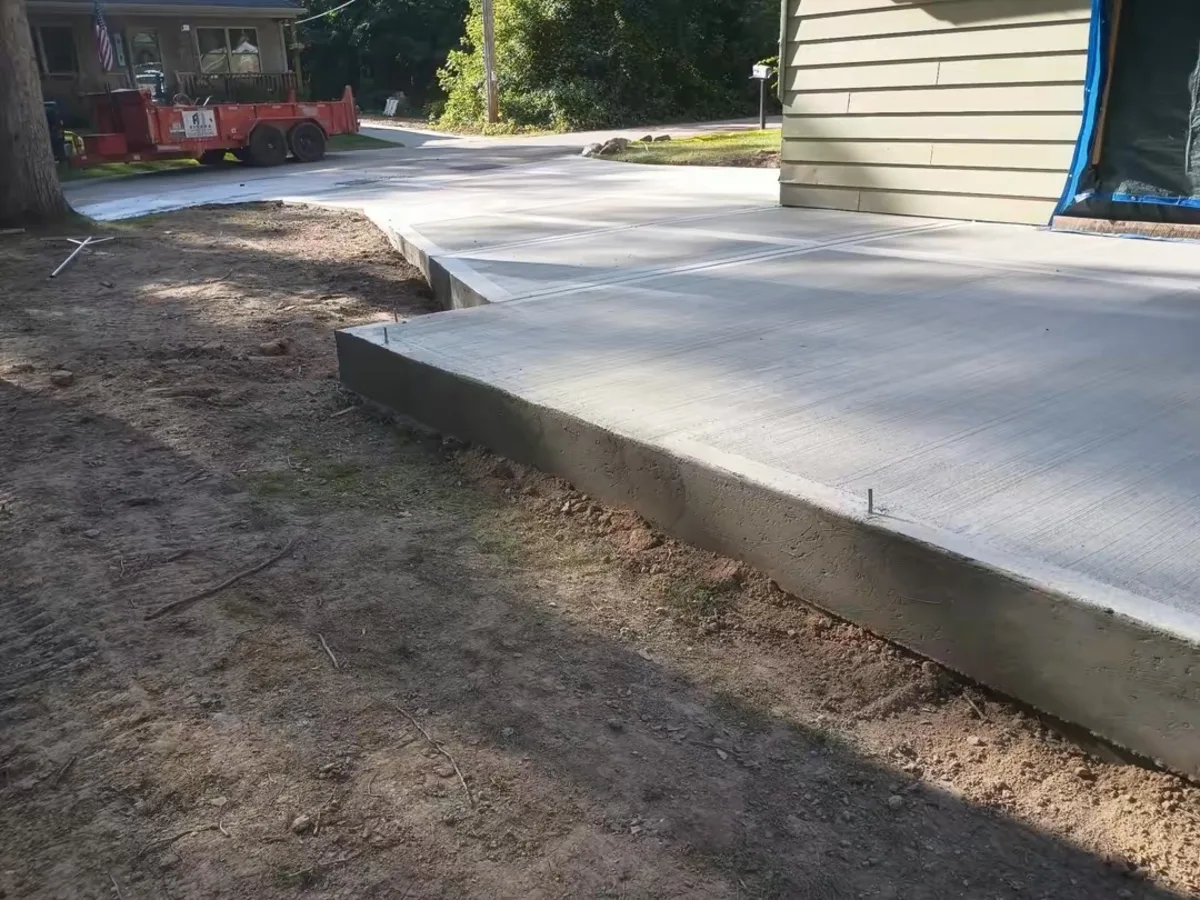
Our standard sub-base specification is 4–6 inches of compacted CA-6 (Illinois DOT-graded crushed limestone) over undisturbed or properly compacted subgrade. CA-6 is preferred over rounded gravel because the angular stones lock together when compacted, creating a stable base that won't pump or settle. We compact in 2-inch lifts with a plate compactor and check density before forms go in.
Spec #5: Thickness
For Northern Illinois residential applications, our minimum thicknesses are:
- • Sidewalks and walkways: 4 inches
- • Patios: 4 inches
- • Standard residential driveways: 4 inches
- • Driveways with heavy vehicles: 5–6 inches with rebar
- • Garage floors: 4–5 inches with vapor barrier and rebar
- • Commercial drives: 6–8 inches with engineered reinforcement
Spec #6: Reinforcement
Reinforcement doesn't prevent cracks — properly placed control joints do that — but reinforcement holds the slab together when cracks happen, preventing differential heaving during freeze cycles. For residential driveways and patios, we set #4 Grade 60 rebar on chairs in the lower third of the slab — where tension develops when a wheel load or shifting soil tries to bend the concrete. We don't use wire mesh: pulled up by hand mid-pour, it lands at random depths and can't reliably hold cracks tight. Fiber reinforcement (synthetic polypropylene fibers mixed into the concrete) is excellent for controlling shrinkage cracking but doesn't replace properly chaired rebar.
Spec #7: Control Joints
Concrete will crack — the question is where. Control joints are intentional weak lines that direct cracking to predictable, manageable locations. Standard practice in Illinois is control joints every 8–10 feet, cut to 1/4 the slab depth (1 inch deep for a 4-inch slab), and ideally formed within 6–12 hours of pour using a soft-cut saw. Skipping joints or spacing them too far apart guarantees random cracking that freeze-thaw will widen every winter.
Spec #8: Curing
Concrete doesn't dry — it cures through a chemical reaction (hydration) that needs water. If concrete dries too fast, the surface never reaches design strength and becomes weak, dusty, and prone to scaling. We apply a curing compound immediately after finishing, or use wet burlap and plastic sheeting for the first 7 days. Concrete poured in May without proper curing can lose 30% of its potential strength — and in Northern Illinois, that 30% is the difference between a 30-year driveway and a 12-year driveway.
Spec #9: Sealing
New concrete should be sealed roughly 30 days after pour, then re-sealed every 2–3 years. We recommend penetrating silane/siloxane sealers because they chemically bond with the concrete and don't peel or yellow. Topical acrylic sealers look great initially but fail within a few seasons under Illinois conditions. Sealing is what protects your concrete from de-icing salt absorption and dramatically extends freeze-thaw life.
What This Looks Like on Your Estimate
When you're comparing concrete contractors in McHenry or Lake County, look for these specifications written into the proposal: PSI rating, air-entrainment percentage, water-cement ratio, sub-base material and depth, slab thickness, reinforcement type, and control joint spacing. If the estimate just says "4-inch concrete driveway" with no other detail, you have no way to know whether you're getting freeze-thaw-rated concrete or a slab that won't survive a decade.
Get Concrete Built for Illinois Winters
Every driveway, patio, garage floor, and sidewalk we pour at RCC Masonry & Concrete is built to ACI Class F freeze-thaw specifications — and we put every mix design in writing on our estimates. We serve all of McHenry County and Lake County. Call (224) 441-5284 or request a free estimate to see exactly what specs we'll use on your project.